The Malaysian property management industry is at an inflection point. With the Strata Management Act 2013 and its subsequent amendments pushing for transparency and digital record-keeping, property managers who haven't digitalized are falling behind. This guide covers everything you need to evaluate, choose, and implement property management software.
Why Digitalize Now?
Malaysian property managers should digitalize in 2026 because regulatory pressure, resident expectations, and rising labor costs have all hit at once — manual portfolios can no longer scale, and JMBs running on paper risk both COB scrutiny and resident churn. Three converging forces make this the inflection year:
- Regulatory pressure — The Commissioner of Buildings increasingly expects digital records and transparent financial reporting from JMBs and MCs
- Resident expectations — Post-pandemic, residents expect mobile apps, online payments, and instant communication
- Operational efficiency — Labor costs are rising, and manual processes simply can't scale across large portfolios
Core Modules You Need
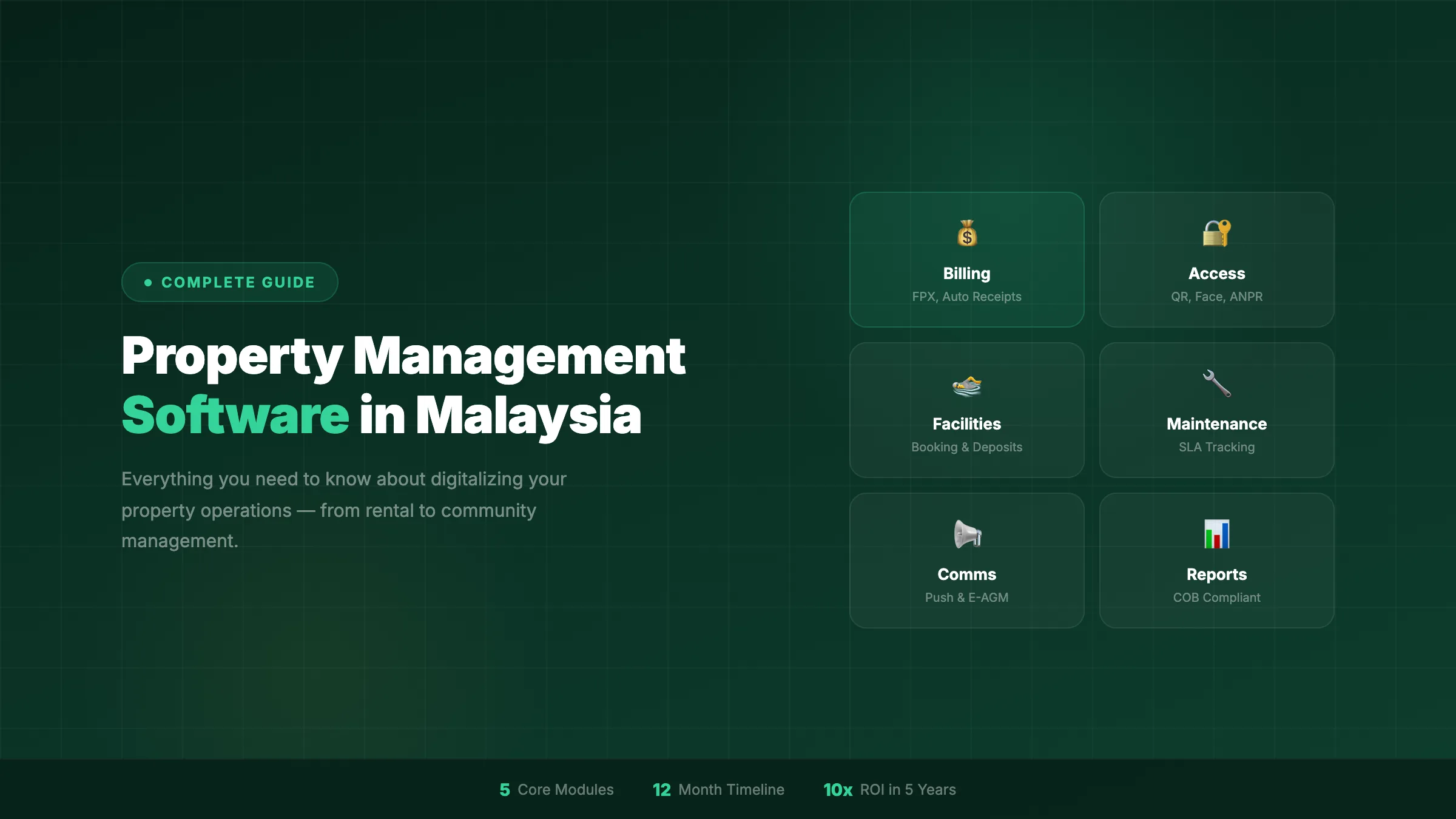
A complete property management platform needs five core modules: financial management (maintenance fees, FPX collection, audit-ready reports), visitor and access control, facility booking, maintenance and defect reporting, and resident communication. Anything less leaves a manual workflow in the gap. Based on our experience building these platforms — including the iCARES smart community platform — these are the essentials:
- Financial Management — Maintenance fee calculation (including sinking fund), payment collection via FPX, automated receipts, and auditable financial statements
- Visitor & Access Control — QR-based pre-registration, real-time guard notifications, vehicle plate recognition, and delivery management
- Facility Booking — Calendar-based booking for halls, courts, and pools with deposit management and usage reports
- Maintenance & Defects — Photo-based defect reporting, work order management, vendor assignment, and SLA tracking
- Communication — Announcements, push notifications, e-AGM voting, and community forums
Integration Requirements
Your property management software should integrate with the following:
Build vs Buy
Build custom when your portfolio exceeds 20 communities, has unique workflows, or you want to monetize the platform itself. Buy off-the-shelf (Jaga, i-Neighbour, TimeTec) when you have under 20 communities and standard workflows. Custom platforms cost 2–3x more upfront but deliver 5–10x better ROI over 5 years — a pattern we explore further in why Malaysian enterprises choose custom software over SaaS.
Our iCARES case study is a prime example of this approach in action — and the architecture you choose matters as much as the build/buy decision, which we cover in Next.js vs WordPress for business sites.
"The best property management software is one that your guards, managers, and residents actually want to use. Technology that sits unused is worse than no technology at all."
Implementation Timeline
A 50-community portfolio takes roughly 12 months end-to-end: 2 months for discovery and design, 3 months for core module development, 2 months for pilot deployment, 3 months for iteration and additional modules, and 2 months for full rollout with training. Skipping the pilot phase is the #1 reason rollouts fail.
- Month 1-2: Requirements gathering, workflow mapping, and system design
- Month 3-5: Core module development (financial + access control)
- Month 6-7: Pilot deployment at 3-5 communities
- Month 8-10: Iteration based on feedback, additional module development
- Month 11-12: Full portfolio rollout with training and support
Choosing a Development Partner
When evaluating software development companies for your property management project, look for domain expertise (have they built proptech before?), local presence (do they understand Malaysian regulations?), and a portfolio of similar-scale deployments. The cheapest quote almost always ends up being the most expensive project.