For many small studios in Malaysia, WhatsApp is usually the first booking tool. Customers already use it every day, so it feels natural to let them message:
“Any slot tonight?”
“Can I join the 7 PM class?”
“Can I change my booking to tomorrow?”
When the business is still small, this works. The problem starts when the number of classes and members grows. One customer asks about availability, another wants to cancel, someone sends a payment screenshot, and a member wants to know how many credits are left in their package.
None of these tasks is difficult by itself. The problem is that every message requires someone to check another record, reply manually and remember to update it.
That is where an online booking system for classes starts becoming useful.
When WhatsApp Booking Starts Becoming a Problem
WhatsApp is a good communication tool. It is not always a good booking database.
Imagine a dance studio running several classes in one evening. A member asks whether the 7 PM class still has space. While the staff is checking, another member sends exactly the same question.
At the same time:
Someone wants to cancel tomorrow’s class
Another member has just bought a new package
A customer sends a bank transfer screenshot
Someone wants to know when their package expires
The busier the studio becomes, the more difficult it is to keep everything accurate.
Common problems include:
Accepting too many bookings for one class,
Forgetting to deduct package credits,
Missing package expiry dates,
Manually checking payment screenshots,
Losing cancellation messages inside long WhatsApp chats,
Staff using different versions of the same spreadsheet.
At this point, the problem is no longer just “booking”.
It is the amount of admin work happening behind every booking.
What Is an Online Booking System for Classes?
An online class booking system allows customers to check available classes and reserve a slot without waiting for staff to reply.
Instead of sending:
“Any class available tonight?”
the customer can open the class schedule, check the available times and book directly.
But a proper class booking system should also update the business side automatically. A typical customer journey may look like:
Customer journey
View timetable → Select class → Book → Pay
Business side
Booking received → Seat updated → Package checked → Credit recorded → Booking data stored
This connection is important.
Simply adding a booking form to a website does not save much time if staff still need to copy every booking into Excel afterwards.
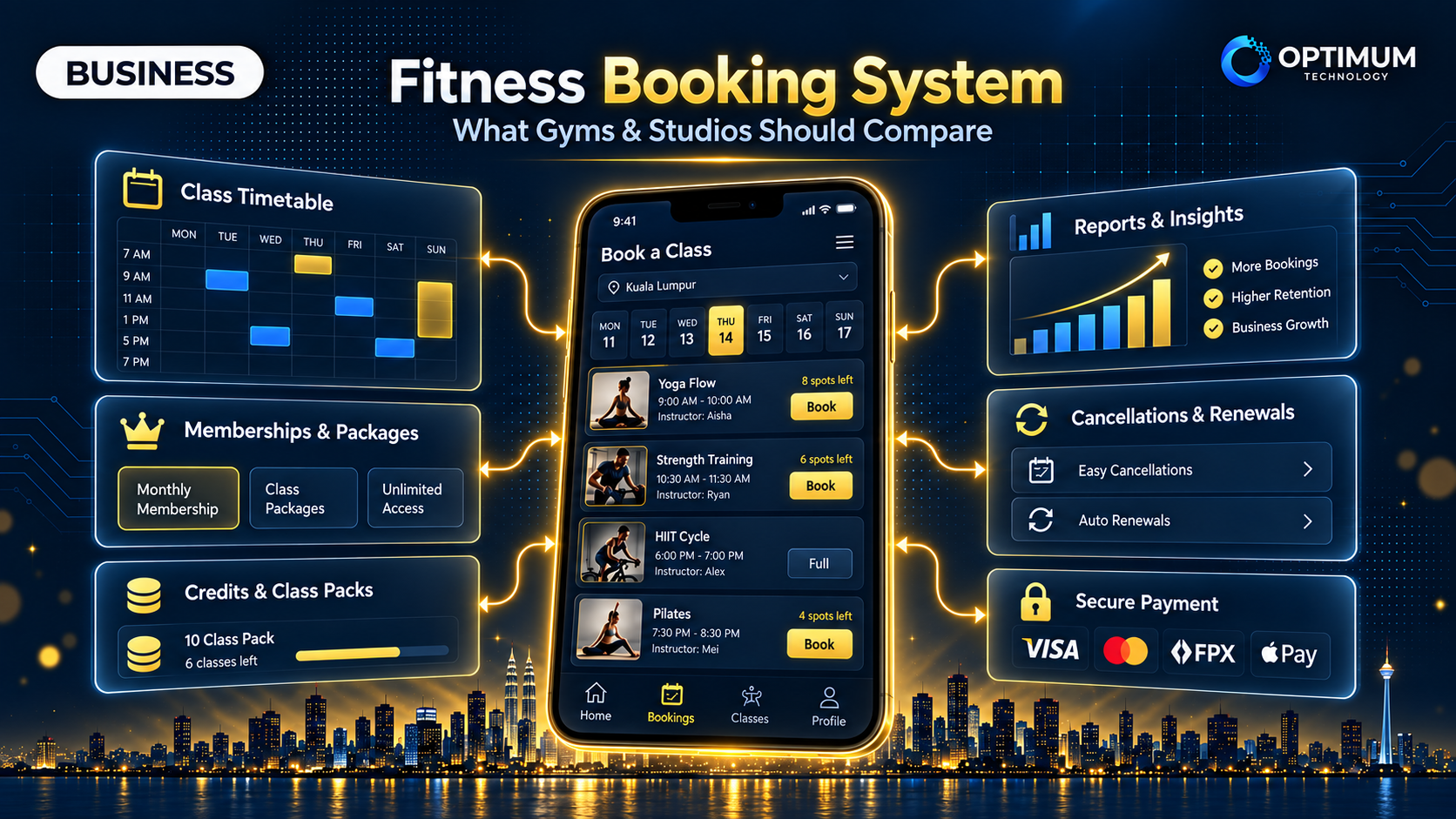
If you are comparing complete platforms rather than individual features, you can also read our Fitness Booking System in Malaysia guide.
👉 Read: Fitness Booking System in Malaysia — What Gyms & Studios Should Compare
What Should a Class Booking System Actually Handle?
Different businesses need different features, but there are several things a class-based business should normally look for.
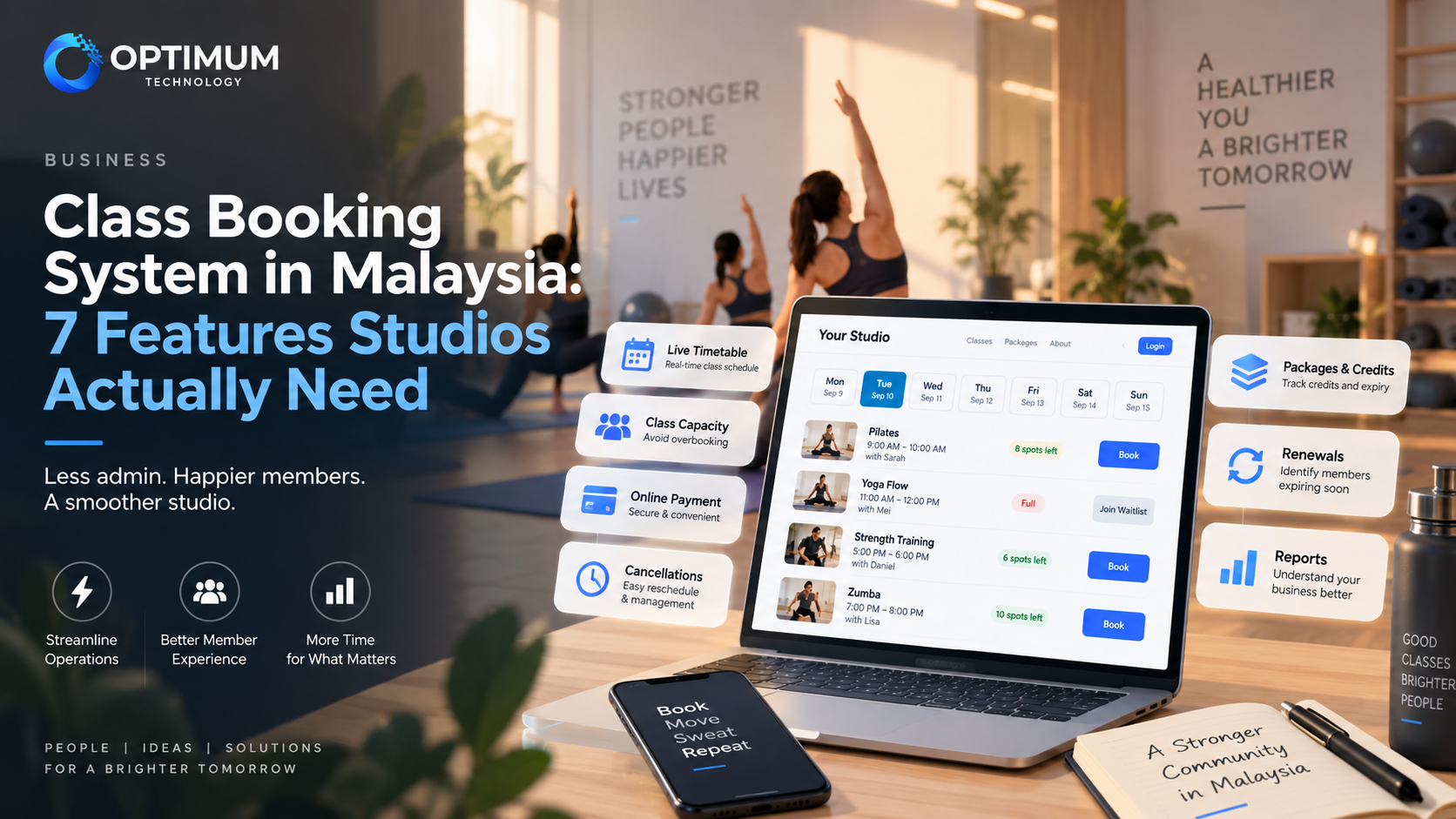
1. A Live Class Timetable
Customers should be able to see upcoming classes, available times and instructors without contacting the business first.
If a class is full or unavailable, the timetable should reflect that. This reduces the number of messages asking the same question:
“Still got slot?”
A live timetable also gives customers the freedom to check classes outside business hours instead of waiting for staff to reply.
2. Class Capacity
A studio with 15 spaces should not accidentally accept a 16th booking.
A booking system should automatically track the number of available seats and stop accepting bookings once the class reaches its limit.
This is especially important for businesses such as:
Pilates studios
Yoga studios
Swimming schools
Dance classes
Small group fitness sessions.
Capacity should also be flexible because not every class has the same limit.
A Pilates class with 10 reformers may only allow 10 members, while another class in a larger room may allow 20.
The system should handle that automatically instead of asking staff to count bookings manually.
3. Packages and Credits
Many class-based businesses do not charge customers one class at a time.
They may sell packages such as:
5-class package
10-class package
Monthly membership
30-day package
That means the system needs to understand more than just bookings.
It should also help track: Remaining credits, package validity, credit deductions, expiry dates, renewals
For example, if a member buys a 10-class package and attends one class, the system should update the balance automatically.
Without this, staff often end up managing bookings in WhatsApp and package balances somewhere else in Excel.
That is exactly the kind of repeated admin a booking system should reduce.
4. Online Payment
The booking experience becomes much easier when customers can book and pay as part of the same process. Without online payment, the workflow often looks like:
Book through WhatsApp → Transfer money → Send screenshot → Staff verifies payment → Staff updates record
That may be manageable when it happens a few times a week. It becomes much more frustrating when it happens dozens of times.
Before choosing a system, check:
Which payment methods are supported,
Where the payment goes,
Whether staff can record manual payments,
Whether customers can buy packages online,
Whether there are extra transaction or platform fees.
“Online payment supported” is not enough information. The complete payment flow matters.
5. Cancellations and No-Shows
Customers will sometimes cancel. Some may also book a class and simply not attend. A class booking system should help the business apply its cancellation rules consistently.
For example, a studio may decide:
Cancellations are allowed until 6 hours before class,
Late cancellations still use one credit,
No-shows do not receive their credit back,
Staff can manually restore a credit for exceptional cases.
The exact policy depends on the business. What matters is that staff should not need to decide and update everything manually every time someone cancels. A clear system also makes the rules easier for customers to understand.
6. Renewal Tracking
A member whose package is about to expire is very different from a completely new customer. They already know the business. They may simply need a reminder to renew. A good class booking and membership system should make it easy to identify customers whose packages are approaching expiry.
For example, staff may want to know:
Which packages expire this week
How many credits each member still has
Who has stopped attending
Which members may need a renewal reminder
This is useful because growth is not only about getting new customers. Keeping existing members is just as important.
WhatsApp vs Online Booking System
Task | WhatsApp + Spreadsheet | Online Booking System |
|---|---|---|
Check class availability | Customer asks staff | Customer checks timetable |
Confirm available seats | Staff checks manually | System tracks capacity |
Record booking | Staff enters manually | Booking recorded automatically |
Track package credits | Spreadsheet/manual check | System updates records |
Check expiry dates | Staff searches records | Expiring packages can be identified |
Payment | Screenshot sent to staff | Customer can pay online |
Booking after business hours | Wait for staff reply | Available anytime |
Reporting | Prepared manually | Booking data already stored |
This does not mean businesses need to stop using WhatsApp.
WhatsApp is still useful for enquiries, reminders and customer support.
The difference is that WhatsApp no longer needs to be the place where the entire booking operation is managed.
Which Businesses Need a Class Booking System?
A class booking system is most useful for businesses that run scheduled sessions with limited capacity.
Dance Studios
Dance studios often run different classes based on level, instructor, dance style and time. Members may also buy packages instead of paying class by class.
Once the timetable becomes busy, manual booking becomes harder to manage.
Yoga and Pilates Studios
These businesses normally have limited spaces for every session. This makes capacity management important, especially during popular time slots.
Swimming Schools
Swimming lessons may be organised by instructor, skill level, pool and time. Parents also need a simple way to check schedules and manage bookings.
Gyms and Fitness Studios
Group classes, personal training sessions and membership packages may all need different booking records.
Tuition and Other Class-Based Businesses
Any business where customers repeatedly choose from a fixed timetable can benefit from a booking system once manual administration becomes too time-consuming.
A simple question can help:
How many times does your team answer “Is there still a slot?” every week?
If the answer is “a lot”, part of that process can probably be automated.
What to Look for Before Choosing a Booking System
A system with more features is not automatically better. The important question is whether it matches the way your business actually operates.
Before choosing a booking system for your business in Malaysia, consider the following.
Can customers book easily from their phones?
Most customers will probably book from their phones, the process should be simple and should not require unnecessary steps.
Can it manage the packages you already sell?
If your studio uses credits, memberships and expiry dates, make sure the system can support them. A system designed only for simple one-off appointments may not be suitable.
Can you control class limits?
Your business should be able to decide how many people can join each class.
Can customers pay online?
Check which payment methods are available and how the payment process works.
Can you access your customer records?
Your member information is important. Make sure the system gives you access to the data you need for daily operations and reporting.
Will your staff actually use it?
A system should reduce admin work, not create a new technical problem. If staff need constant assistance just to manage normal bookings, the system may be too complicated.
When a Booking System May Not Be Necessary
Not every business needs a booking system immediately.
If you only run a few private sessions every week, your booking volume is low and every customer needs a personal discussion before confirming, WhatsApp may still be enough.
The problem usually starts when staff are repeatedly doing the same tasks:
checking slots
updating spreadsheets
verifying payments
tracking credits
checking package expiry
answering the same availability questions
That is the point where automation starts to make more sense. The goal is not to digitise everything.
It is to reduce work that your team should not need to repeat manually every day.
The Bottom Line
An online booking system for classes should do more than collect booking requests.
For a class-based business, it should connect the timetable, available seats, members, packages, payments and renewals into one process.
Customers get a simpler way to book, staff spend less time answering availability questions and updating records, and the business gets one place to see what is happening.
For studios that are still managing most of their bookings through WhatsApp and spreadsheets, the right time to consider a booking system is usually before the process becomes completely unmanageable.
Looking for a Class Booking System in Malaysia?
If your studio is currently managing bookings, packages and payments across WhatsApp and spreadsheets, SenangBook brings these tasks into one system.
Members can view available classes, book slots and manage their packages online, while your team can keep track of class capacity, credits, payments and renewals from one place.
How to Move Your Classes Online
You do not need to change everything at once.
Start with these steps:
1. List your current classes
Write down each class, instructor, time and maximum capacity.
2. Define your packages
Record the price, number of credits and validity period for each package.
3. Decide your booking rules
Set rules for booking, cancellation, no-shows and credit deductions.
4. Prepare your existing member records
Gather your current customer information from Excel or other records.
5. Test the booking process yourself
Try booking a class from your phone.
If the process is confusing for you, it will probably be confusing for customers too.
6. Keep WhatsApp for communication
You do not need to stop using WhatsApp.
Instead, use it for customer communication while directing bookings to the online timetable.