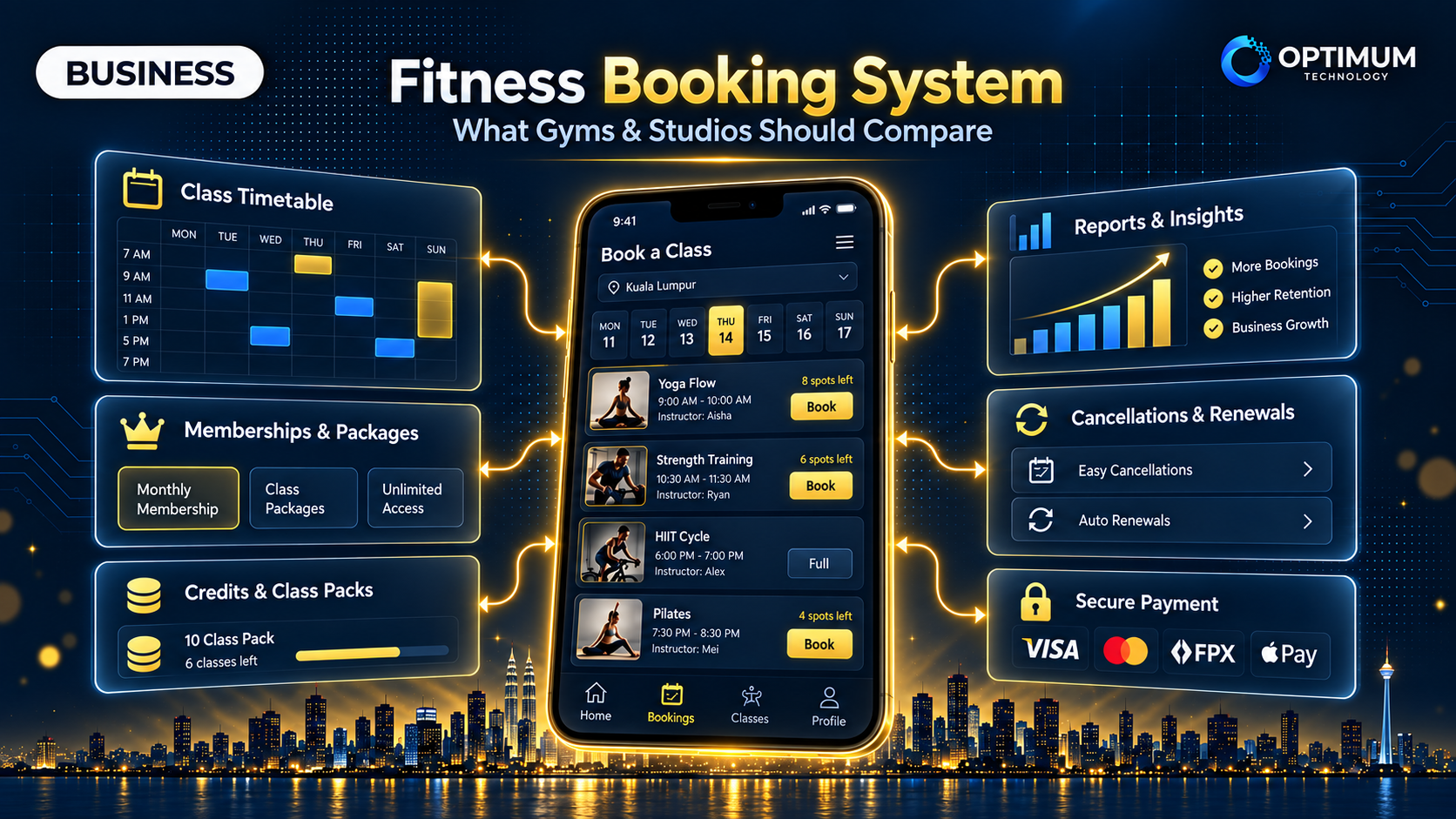
Running a fitness studio usually does not become difficult because of one big problem. It becomes difficult because of twenty small ones.
A member asks whether tonight's Pilates class still has space, another wants to cancel, someone has three credits left but cannot remember when the package expires, a new customer sends a bank transfer screenshot.
The instructor wants to know who is coming tomorrow, and the owner is trying to work out which classes actually made money this month. At first, WhatsApp and Excel can handle most of this, but once bookings, members and classes increase, the admin starts becoming a business process of its own.
That is usually when owners begin looking for a fitness booking system in Malaysia.
The difficult part is that almost every platform promises the same things:
Booking. Memberships. Payments. Reports.
So how do you actually compare them? The answer is not to choose the system with the longest feature list. It is to find the system that fits the way your studio really operates.
First: What Does a Fitness Booking System Actually Do?
A basic booking tool answers one question:
“Is this time available?”
A fitness or studio booking system usually needs to answer several more:
Does the member have a valid package?
How many credits are left?
Is the class already full?
Can the member still cancel?
Should a no-show lose a credit?
Has the customer paid?
When does the membership expire?
Which classes are actually being attended?
Who needs to be followed up for renewal?
That is why a studio system is different from a simple appointment calendar. Booking is only one part of the workflow.
A typical customer journey may look like:
View timetable → Buy package → Pay → Book class → Attend → Credit deducted → Renew
The studio side needs to keep all of those steps connected.
1. Start With the Type of Business You Run
Before comparing software, identify what you actually sell. Different fitness businesses need different booking logic.
Gym
A traditional gym may focus more on membership access, personal training, recurring billing, member records and branch management.
Pilates or Yoga Studio
A Pilates or yoga studio may care more about limited class capacity, class packs, instructor schedules, waitlists, reformer or room availability, cancellations and no-shows.
Dance Studio
A dance studio may also need to manage different levels, multiple instructors, courses, packages, student attendance and parent or student records.
Swimming School
Scheduling can become more complicated because it may involve the coach, pool, level, student age, lesson type and repeated weekly schedules.
This matters because a system built around open-gym memberships may not be ideal for a studio that sells 10-class packs. At the same time, a powerful international studio platform may be unnecessary for a small business that only needs a timetable, credits and online payment.
2. Class Booking and Capacity Should Be Automatic
This sounds obvious, but it is one of the first things to test properly. Suppose a class has 12 spaces. The system should automatically track:
12 available → 11 → 10 → … → 1 → Full
Staff should not need to manually count names in WhatsApp. You should also check whether different classes can have different capacities, whether customers can see when a class is full, whether staff can override the limit, whether there is a waitlist and what happens when someone cancels.
Some platforms go further. Momence, for example, supports classes, appointments, workshops, events and space bookings in the same scheduling environment, while Glofox supports booking and scheduling alongside membership management and payments.
The right level of complexity depends on your studio. Do not pay for a sophisticated scheduling engine if you only run six fixed classes every week.
3. Memberships, Packages and Credits Matter More Than the Calendar
For many studios, this is the real core of the system. A customer may buy a 5-class package, a 10-class package, a monthly unlimited membership, a 30-day package, an intro package or a single drop-in class.
The system should know how many credits the member has, how many credits each class costs, when the package expires, whether that package can be used for a particular class, what happens after a cancellation and whether unused credits can be restored.
For example, SenangBook allows studios to set the credits, price and validity of each package, with credits deducted automatically when the class runs.
This is much easier to manage than having:
Booking list in WhatsApp
Package balance in Excel
Payment screenshot in another chat
The system should connect them.
4. Check How Payments Actually Work
“Online payment supported” is not enough information. A more important question is:
Where does the money go?
You should also check which payment methods are supported, whether payment is processed under your own merchant account, whether there are additional platform fees, whether payment processing fees are separate, whether staff can record manual payments, whether customers can buy packages online and what happens when a payment fails.
This is especially important when comparing international and Malaysian systems. For example, Momence currently publishes a Free Basic plan and paid plans starting at US$60/month, while some plans also include additional platform percentages on transactions. Its higher Custom plan is listed at US$199/month before standard payment processing costs.
SenangBook uses the studio's own merchant account, so customer payments go through the studio's own website into that merchant setup. Neither model is automatically “better”, but they create different cost structures.
That is why studios should compare total cost, not just the monthly subscription price.
5. Understand the Real Monthly Cost
Booking software pricing can be surprisingly difficult to compare. At the time of writing in September 2026, published starting prices include:
System | Published Starting Price | Pricing Structure |
|---|---|---|
Mindbody | From US$79/month/location | Higher plans via sales |
ABC Glofox | From US$99/month/location | Final pricing depends on plan/business |
Momence | Free / US$60 / US$199 | Some plans include platform fees |
Fitnow | From RM199/month on annual Starter pricing shown | Local fitness platform |
SenangBook | RM350 monthly or RM299/month annual | Same core feature set |
These are published starting figures, not guaranteed total costs. Pricing and promotions can change, so always confirm directly with the provider before purchasing.
Mindbody currently advertises plans from US$79 per month per location, while Glofox states that eligible studio plans can start around US$99 per month per location. Fitnow currently promotes annual Starter pricing at RM199/month, while SenangBook lists RM350 monthly or RM299/month on the annual plan.
But the cheapest subscription is not automatically the cheapest system.
A better calculation is:
Subscription + transaction/platform fees + add-ons + extra branches + migration + staff time = actual cost
That is the number that matters.
6. Decide Whether Your Members Need an App
Apps sound attractive, but ask whether your members genuinely need one. Some international platforms make mobile apps a major part of the experience.
Glofox includes member and staff mobile apps in its platform, while Momence provides its customer app and also offers branded-app options. Other systems take a website-first approach.
SenangBook lets members register, buy packages and book classes directly through the studio's website using a phone browser, without requiring a separate app download.
There is no universal winner here. A larger fitness brand may want a branded app, while a smaller studio may prefer a simpler journey:
Instagram → Website → Book
without asking a first-time customer to install anything.
Think about your actual customers, not just what looks impressive in a software demo.
7. Cancellation and No-Show Rules Should Be Built In
No-shows cost more than one empty spot. They can also prevent another paying customer from joining.
Before choosing a booking system, check whether customers can cancel themselves, whether you can set a cancellation cut-off, whether credits return automatically, whether staff can restore credits manually and whether different packages can use different rules.
For example, SenangBook allows studios to set a cancellation cut-off, and its default no-show logic keeps the class credit unless staff manually restore it for a genuine case.
Whatever system you choose, the rule should be clear. The worst setup is when every cancellation depends on:
“Ask the admin and see.”
A system should make policy consistent.
8. Renewal Tools Can Matter More Than New Bookings
Studios naturally focus on getting new members, but losing an existing member because nobody followed up on an expiring package is often easier to prevent.
Ask whether the system can show packages that are expiring soon, remaining credits, inactive members, membership renewal status and attendance history.
SenangBook, for example, has an Expiring Soon list that identifies members whose packages are approaching expiry and allows staff to open WhatsApp directly for follow-up.
Other platforms offer more advanced retention and marketing automation. Momence connects customer booking, attendance, purchase and communication data to automated customer journeys, while Mindbody's higher plans include marketing and retention tools.
The question is not whether more automation is better. It is how much automation your business actually needs.
9. Reports Should Answer Business Questions
A dashboard filled with charts is not automatically useful. Start with the questions your business actually needs to answer.
For example:
Which classes are always full?
Which classes have poor attendance?
How much did we sell this month?
Which members are about to expire?
Which branch is performing better?
How often are members attending?
If your team still needs to export everything into Excel before management can understand the numbers, the reporting feature may not be doing enough.
The best report is usually the one that answers:
“What should we do next?”
10. Local Support Can Matter More Than One Extra Feature
This is easy to underestimate when comparing feature lists. Consider what happens when payment is not working, members cannot book, staff cannot understand a setting, existing customers need to be migrated or tomorrow's timetable is wrong.
International platforms may offer larger support operations and broader ecosystems. Local providers may offer easier communication, Malaysian working hours, local onboarding and a better understanding of the way customers pay and communicate here.
For example, Fitnow positions itself specifically around Malaysian fitness businesses and local payment methods, while SenangBook provides WhatsApp support during Malaysian business hours.
Do not only ask:
“Does this software have support?”
Ask:
“When something goes wrong at my studio, how do I actually get help?”
11. Check Who Owns Your Data
Before signing up, ask whether you can export member data and booking history, what happens if you cancel, how long the data is retained, whether migration is supported and whether there is a fee to import existing members.
This matters because changing software later becomes much harder when the studio cannot easily retrieve its own records.
SenangBook states that studio data belongs to the customer and can be exported, with data retained for 30 days after subscription cancellation for export or restart.
Whatever provider you choose, ask the same question.
Your booking software may change. Your customer list should still belong to your business.
International vs Local Booking Systems
There is no simple rule that says local is better or international is better. They usually optimise for different things.
Consideration | International Platform | Local / Malaysia-Focused System |
|---|---|---|
Global ecosystem | Often stronger | Usually smaller |
Advanced marketing tools | Often more extensive | Depends on provider |
Branded mobile apps | Common on larger platforms | Varies |
MYR pricing | May involve USD conversion | Usually easier |
Local payment workflow | Must verify | Often designed locally |
Malaysian support hours | Depends on provider | Usually easier |
Feature complexity | Often broader | Can be simpler |
Local onboarding | Varies | Often more hands-on |
A multi-location chain with a large marketing team may benefit from a broader international ecosystem. A studio with 150 members may simply want bookings, packages, payment, renewals and reports without managing a complicated platform.
The right answer depends on the business.
5 Questions to Ask in Every Demo
Do not let each vendor control the demo. Give every provider the same five scenarios.
1. “Show me how a new customer books and pays.”
Do not accept slides. Watch the actual process.
2. “A member has three credits left. Show me what happens after they book.”
You want to see how package logic works.
3. “This class is full. What happens to the next customer?”
This tests capacity and waitlist behaviour.
4. “This member's package expires next week. How do I know?”
This tests retention and renewal visibility.
5. “I want to leave next year. Show me how I export my member data.”
This tests something many businesses only think about when it is too late.
If a system cannot clearly demonstrate your normal daily workflow, its feature list does not matter.
When WhatsApp and Excel Are Still Enough
Not every studio needs software immediately. If you run only a few classes, have a small number of members, rarely reach class capacity, do not sell complicated packages and can manage renewals easily, WhatsApp and Excel may still work.
Buying software too early can create more admin, not less.
The warning signs usually appear when staff spend more time answering “still got slot?”, checking credits, reconciling screenshots, updating spreadsheets and chasing renewals than they should.
That is when the system starts paying for itself in saved work.
The Bottom Line
The best fitness booking system in Malaysia is not necessarily the system with the most features. It is the one that matches the way your studio earns money and serves members.
Before choosing, compare:
Booking · Capacity · Packages · Credits · Payments · Cancellations · Renewals · Reports · Support · Data Ownership · Total Cost
A Pilates studio with 80 members may need something very different from a gym chain with 10 locations.
Start with your workflow. Then choose the software — not the other way around.
Where SenangBook Fits
SenangBook is built for Malaysian class-based businesses including dance studios, gyms, swimming schools, yoga studios and Pilates studios.
It focuses on the operational flow many smaller and growing studios need every day:
Live timetable → Package purchase → Online payment → Class booking → Automatic credit tracking → Renewal follow-up
Members book through the studio's own website rather than needing a separate app, while the business keeps control of its merchant account and can export its data. Current pricing is RM350 monthly or RM299/month on the annual plan, with no standard setup fee.
It will not be the right choice for every studio. If you need a large global marketplace, extensive enterprise marketing automation or a branded app ecosystem, compare those requirements with platforms such as Mindbody, Momence or Glofox.
But if your current problem is mainly:
WhatsApp + Excel + payment screenshots + package tracking + renewals
SenangBook is designed specifically around that workflow.