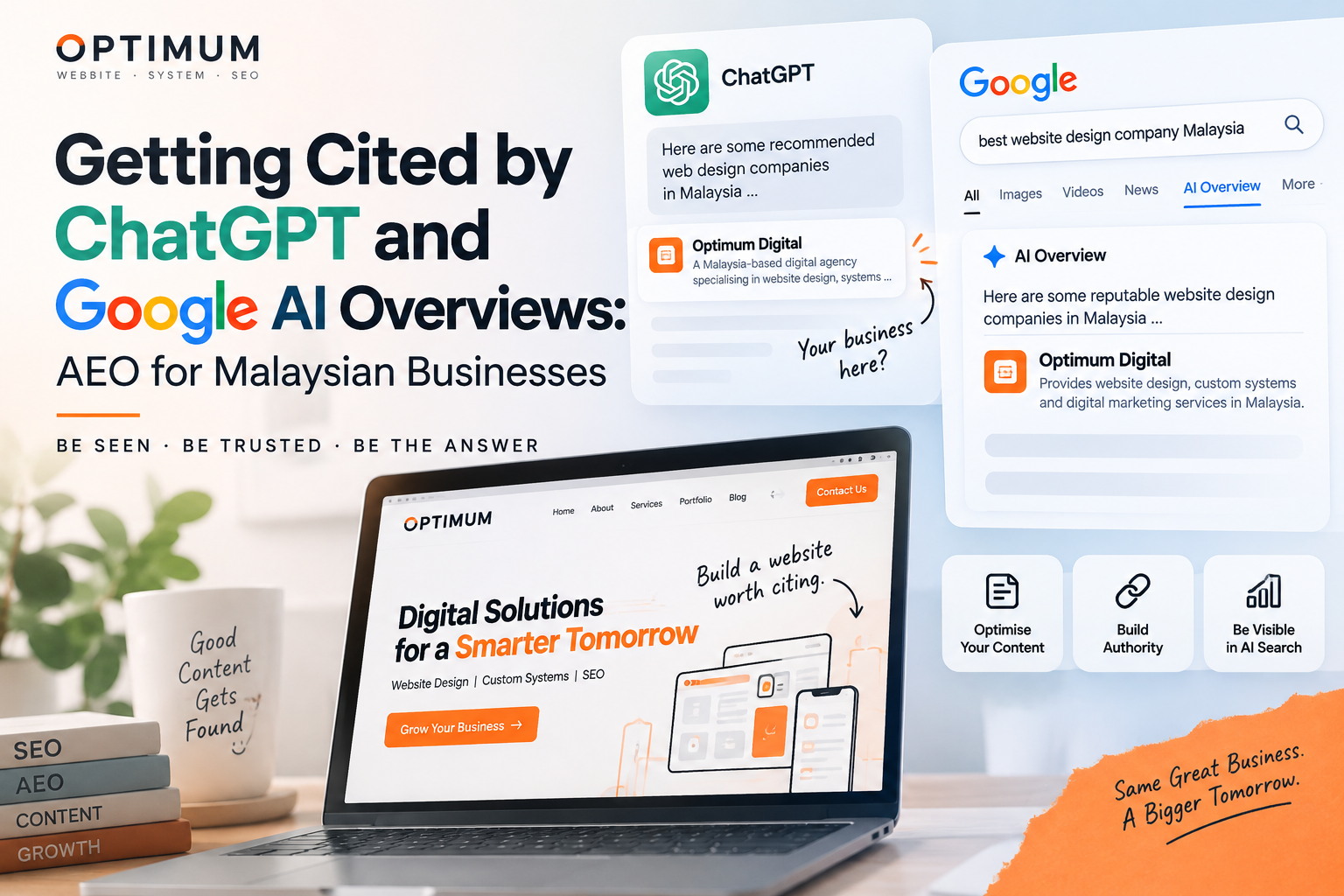
You ask ChatGPT:
“What is the best booking system for a Pilates studio in Malaysia?”
Or Google:
“How much does SEO cost in Malaysia?”
Instead of giving you ten blue links, the search experience may now generate an answer, compare several options and cite the sources it used.
For a Malaysian business, that creates a new question:
“How do we become one of the websites that AI actually cites?”
This is where terms such as AEO — Answer Engine Optimisation — and GEO, or Generative Engine Optimisation, have become popular.
But there is an important reality check.
Google's current guidance says its generative AI search features still depend on the same Search index, ranking systems and SEO foundations used across Google Search.
There is no secret AI schema, special Markdown file or magic prompt that guarantees a citation.
ChatGPT Search is similar in one important way: the content first needs to be discoverable before it can become useful as a source.
SEO vs AEO: What Actually Changes?
| Traditional Search | AI Search | What Your Website Needs |
|---|---|---|
| User searches a keyword | User may ask a complete question | Pages that answer real questions clearly |
| Google ranks pages | AI may combine information from several sources | Specific facts and passages worth citing |
| One query may produce one SERP | AI systems may explore related subtopics | Strong topic clusters, not one isolated page |
| Goal is ranking and clicks | Goal can include citation, recommendation and clicks | Authority, clarity and extractable information |
1. AEO Is Not a Replacement for SEO
This is the first misconception to remove.
Google now explicitly describes generative AI optimisation as part of Search optimisation rather than an entirely separate discipline.
To be eligible as a supporting source in Google AI features, a page still needs the basics:
- Google must be able to crawl it.
- The page needs to be indexed.
- It must be eligible to appear with a Search snippet.
- The content should follow normal Search quality and spam policies.
- Important information should be available in readable text.
So if your website still has indexing problems, weak internal links, thin service pages and duplicated content, adding “AEO” to the marketing plan does not skip those problems.
If you are not sure whether Google understands your existing pages properly, start with our guide to websites that are indexed but still not ranking.
2. Make Sure ChatGPT Can Actually Discover the Website
For ChatGPT Search, OpenAI publishes its own search crawler called OAI-SearchBot.
Public websites can appear in ChatGPT Search, but if OAI-SearchBot is blocked by robots.txt or by your hosting or CDN configuration, your content may be harder to surface as a quoted or summarised source.
This is different from trying to “optimise the wording for ChatGPT”.
The first technical question is much simpler:
Can the search system access the page at all?
For a business website, check:
- robots.txt rules,
- noindex directives,
- CDN or firewall restrictions,
- canonical URLs,
- and whether the important information is available on the public page.
Crawlability does not guarantee that ChatGPT will cite the page.
It simply gives the content the opportunity to be considered.
3. Give AI Something Worth Citing
This is where many “AEO articles” become too abstract.
An AI system does not need another source saying:
“SEO is important because it helps businesses improve online visibility.”
There are thousands of pages that can provide that sentence.
A much more useful source might say:
“In Malaysia, ongoing SME SEO retainers commonly sit in the low-thousands of Ringgit per month, but the scope changes significantly based on competition, content requirements and technical implementation.”
That passage contains:
- a location,
- a specific topic,
- a useful answer,
- context,
- and a limitation.
That is much more sourceable.
For Malaysian businesses, citation-worthy content often comes from information that generic global articles do not have:
- Malaysia pricing and purchasing decisions,
- FPX and DuitNow payment workflows,
- Johor Bahru or Kuala Lumpur market differences,
- local regulations and operational requirements,
- actual customer questions,
- real project experience,
- product specifications,
- original comparisons,
- and first-party data.
Google's 2026 generative AI guidance specifically places more emphasis on valuable, unique and non-commodity content.
In simple terms:
If anybody can generate your article in 30 seconds without knowing your business, it is probably not your strongest citation asset.
Want AI Search visibility? Start with information only your business can provide.
Generic content is easy to reproduce. Prices, workflows, case studies, comparisons, original experience and local knowledge give a page something worth retrieving.
Explore Our SEO Services → SEO · AEO · Content · Technical SEO · AI Search4. Write Answers That Can Stand on Their Own
AI systems often need to extract a useful piece of information from a larger page.
That does not mean every paragraph needs to sound robotic.
It means important answers should not require the reader to decode five paragraphs of marketing language first.
Compare these two versions.
Version A:
At our innovative company, we believe every business deserves transformational digital solutions tailored to the future.
Version B:
A standard website is usually enough when the goal is marketing and lead generation. Custom software becomes more relevant when the business needs internal workflows, user roles, database logic or integrations that standard website tools cannot handle.
The second version is easier for a human to understand and easier for a search system to use as supporting information.
A practical structure for important answers is:
Answer → Evidence → Context → Limitation
For example:
Answer: SaaS is usually faster and cheaper to start.
Evidence: The product already exists and development cost is shared across customers.
Context: This works well for standard CRM, booking or accounting workflows.
Limitation: Custom development may be more suitable when the workflow is genuinely unique or requires deep integrations.
This is useful writing even if AI Search did not exist.
That is partly why good AEO and good SEO keep overlapping.
5. AI Search Makes Topic Clusters More Important, Not Less
One AI question can contain several questions underneath it.
For example:
“Which SEO agency in Malaysia should I hire for a small business?”
An AI system may need information about:
- SEO companies in Malaysia,
- pricing,
- agency vs in-house,
- local SEO,
- service scope,
- reviews or proof,
- and how to evaluate a provider.
Google refers to this kind of behaviour as query fan-out: the system can explore multiple related searches and data sources while building a response.
This is one reason a topic cluster can be more useful than trying to force every question into one giant page.
For example, our own SEO cluster separates:
- what SEO services actually include,
- Malaysia SEO pricing,
- local SEO and Google Maps,
- agency comparisons,
- and questions to ask before hiring an SEO company.
Each page answers a different intent, while internal links explain how the topics connect.
6. Make Your Business Facts Consistent
AI citation is not only about blog writing.
A business also needs clear entity information.
For a Malaysian company, important facts may include:
- official business name,
- what services or products it provides,
- service locations,
- contact details,
- pricing when publicly available,
- product capabilities,
- and who the service is designed for.
Those facts should not contradict each other across the homepage, service pages, product pages, Google Business Profile and articles.
Structured data can help search engines understand certain information on the page when the markup accurately matches the visible content.
But structured data is not a special AEO shortcut.
Google explicitly says there is no unique AI schema required for AI Overviews or AI Mode.
The information itself still has to be useful and accessible.
7. Show Where Important Claims Come From
If you publish:
“Malaysian consumers prefer X.”
the reader should be able to ask:
“According to whom?”
This becomes especially important in content about:
- prices,
- statistics,
- regulation,
- payment methods,
- market size,
- software features,
- and competitor comparisons.
Use official or primary sources where possible, state when information was checked and distinguish public facts from your own experience or opinion.
For your own business claims, first-party evidence is useful.
Instead of:
“Our system works for large studios.”
a stronger claim is:
“SenangBook is currently running in a studio environment with a student base of more than 3,400 records.”
It is specific.
It is verifiable internally.
And it does not claim more than the evidence proves.
8. Local Information Is an Advantage Malaysian Businesses Should Use
A Malaysia-based SME is unlikely to beat giant international publishers by rewriting the same global article.
It can compete by answering questions those publishers do not answer properly.
For example:
- What does a booking system cost in RM?
- Does it support Malaysian payment workflows?
- What changes between a RM3,000 and RM30,000 website?
- How should a JB business approach Google Maps?
- Which software model makes sense for a Malaysian SME?
- What does a local studio actually need from its booking system?
This is useful for classic Search.
It is also useful when an AI system needs a specific Malaysian source to support a local answer.
Do not remove the local detail because you think an article needs to sound more “international”.
Sometimes the local detail is exactly what makes the page difficult to replace.
9. What You Do Not Need to Do for AEO
| Claim | Reality | Better Use of Time |
|---|---|---|
| “We need a special AI schema.” | Google says no special AI schema is required. | Use valid structured data that matches visible content. |
| “llms.txt will make us rank in Google AI.” | Google says llms.txt does not affect its Search visibility or ranking. | Fix crawling, indexing and content quality first. |
| “We need hundreds of AI-generated Q&A pages.” | Scaled low-value content can violate Search spam policies. | Publish fewer answers with real information. |
| “AEO replaces SEO.” | Google's generative AI features still use Search systems. | Build on technical SEO, content and authority. |
| “If we optimise correctly, AI must cite us.” | Neither Google nor ChatGPT guarantees placement. | Improve eligibility, usefulness and source quality. |
There is nothing wrong with experimenting with new standards or tools.
The problem begins when they distract from the fundamentals that actually determine whether the page can be discovered and whether its information is useful.
10. How Do You Measure AEO?
This is still less clean than traditional rank tracking.
Google currently includes traffic from AI Overviews and AI Mode inside the normal Web Search Console Performance reporting rather than giving every AI citation its own separate reporting dashboard.
So you should continue monitoring:
- Queries
- Impressions
- Clicks
- Landing pages
- Conversions
- and changes in search behaviour
For ChatGPT, referral visits can be monitored in analytics when users click through from ChatGPT Search.
But not every citation creates a click.
That means AEO measurement should not become:
“We checked ChatGPT once and our company name appeared.”
A more useful approach is to monitor whether your business is increasingly visible around the questions that matter commercially, and whether that visibility eventually produces qualified visits, enquiries or brand searches.
A Practical AEO Checklist for Malaysian Businesses
| Area | Question | What Good Looks Like |
|---|---|---|
| Crawlability | Can Google and relevant search crawlers access the page? | No accidental robots, firewall or noindex blocks |
| Indexing | Is the intended page indexed? | Correct canonical and Search eligibility |
| Answer Quality | Does the page answer a real question directly? | Clear answer followed by useful context |
| Original Value | What does this page have that generic articles do not? | First-party data, experience, pricing or local detail |
| Evidence | Can important claims be supported? | Primary sources, dates and transparent limitations |
| Topic Structure | Is the page connected to related content? | Useful internal links and distinct search intents |
| Business Entity | Are your company facts consistent? | Same services, locations and business information across the site |
| Freshness | Are prices, products and facts still current? | Review important commercial pages regularly |
The Bottom Line
Getting cited by ChatGPT or Google AI Overviews is not about writing for robots.
It is about becoming a better source.
For a Malaysian business, that usually means:
Be Crawlable → Be Specific → Answer Clearly → Add Local Value → Show Evidence → Build Topic Depth → Keep Facts Current
Traditional SEO still matters because AI search systems still need to discover and retrieve information from the web.
What is changing is the shape of the opportunity.
A business does not only want one page to rank for one keyword anymore.
It wants its information to be useful when someone asks:
“How much should this cost?”
or:
“Which option should I choose?”
or:
“What is different in Malaysia?”
The companies most likely to benefit will not be the ones producing the most AI content.
They will be the ones publishing information that AI systems — and humans — actually have a reason to trust and cite.
Want your SEO strategy to work beyond traditional Google results?
Optimum Technology combines technical SEO, search-driven content, local relevance and website implementation so your business can build visibility across both traditional and AI-assisted search.
Explore Our SEO Services → SEO · AEO · Google Search · AI Search · MalaysiaNo SEO, AEO or GEO method can guarantee citation or placement in ChatGPT, Google AI Overviews or AI Mode. The practical goal is to improve crawlability, relevance, usefulness, evidence and source quality so your content is eligible and valuable when AI systems retrieve information.