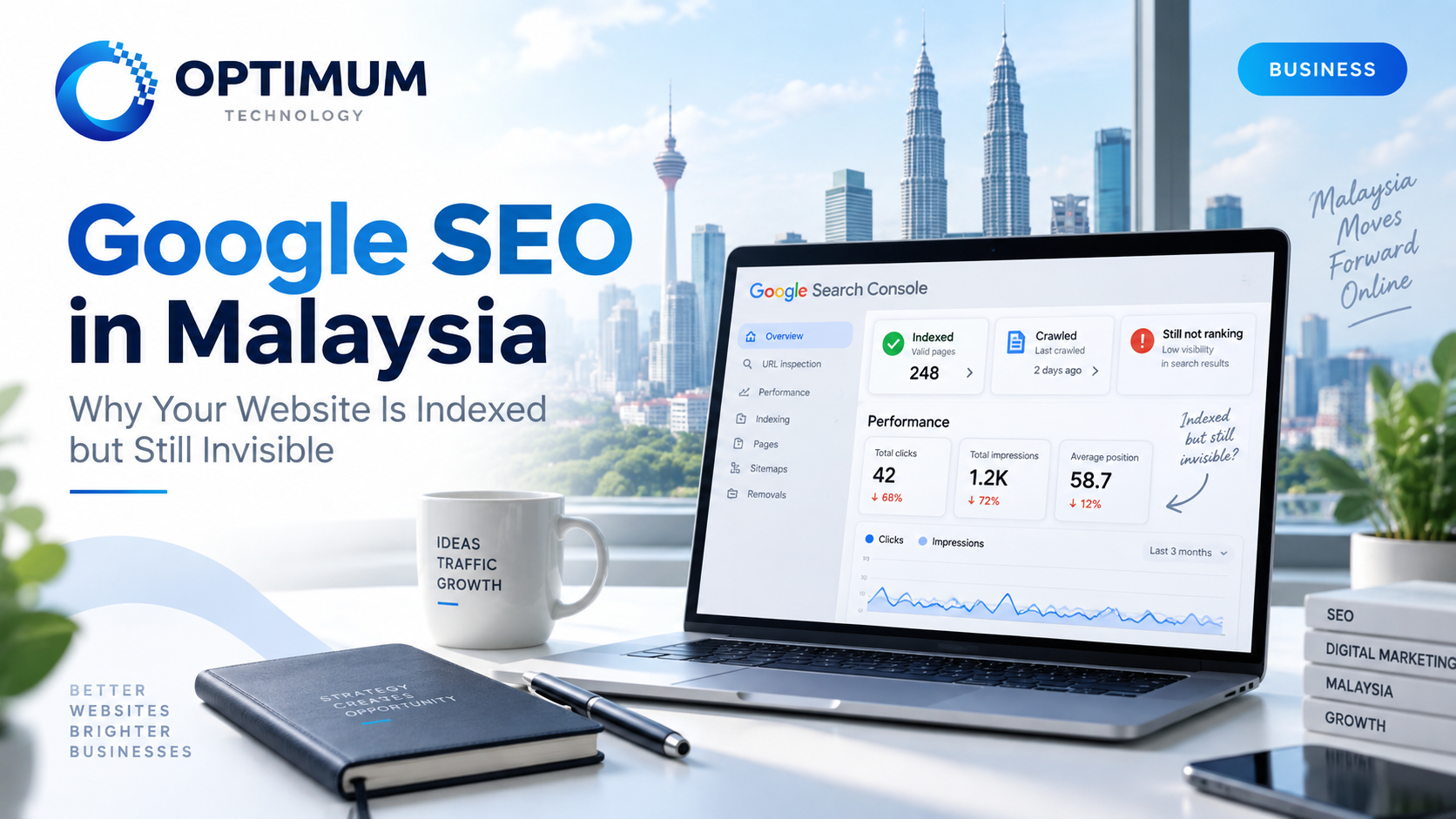
You open Google Search Console, inspect your page and see:
URL is on Google.
Good.
Then you search for the service your business actually wants to rank for.
Page 1: nothing.
Page 2: nothing.
Maybe the website is not even visible after several pages.
This is where many Malaysian businesses confuse indexing with ranking.
They are not the same thing.
Being indexed means Google has discovered and processed the page and may show it in Search. It does not mean Google has decided that your page deserves to rank for the keyword you want.
Indexed vs Ranking: What Is the Difference?
| Status | What It Means | What It Does Not Mean |
|---|---|---|
| Crawled | Googlebot visited the URL | The page is not automatically indexed |
| Indexed | Google processed the page into its index | The page is not guaranteed to rank |
| Ranking | The page appears for a particular search query | The same position will not apply to every query or user |
| Getting Clicks | Users see the result and choose it | Ranking alone does not guarantee traffic |
Google itself explains that a page being indexed makes it eligible to appear in Search, but does not guarantee that it will appear for every search.
So if your page is already indexed, repeatedly clicking “Request Indexing” usually does not solve a ranking problem.
You need to investigate what happens after indexing.
1. Start With Search Console, Not Your Own Google Search
Before changing the page, open Google Search Console and check whether it is already receiving impressions.
Look at:
- Queries
- Impressions
- Clicks
- Average position
- Which page is appearing
This gives you several very different situations.
If the page has zero impressions, Google may not yet see it as relevant enough for meaningful searches.
If it has impressions but the average position is 40–70, the page is visible to Google but not competitive enough yet.
If it is already around position 8–15 but gets almost no clicks, the problem may be the title, snippet or Search Result itself rather than indexing.
And if the page is appearing for completely different queries from the keyword you expected, Google may understand the page differently from you.
That is why Search Console should guide the diagnosis.
Do not change the whole page because you searched your keyword once and did not see yourself.
2. Your Page May Target the Keyword but Miss the Search Intent
A page can contain the exact keyword and still be the wrong result.
Imagine you want to rank for:
“SEO company Malaysia”
But your page is a 600-word educational article explaining:
“What Is SEO?”
Technically, the page talks about SEO.
But someone searching for an SEO company is probably comparing providers, services, proof, pricing or suitability.
The keyword matches.
The intent does not.
Before improving a page, search the target query and study what Google currently rewards:
- Service pages?
- Comparison articles?
- Local businesses?
- Product pages?
- Guides?
Then ask whether your page genuinely belongs in that group.
If you are trying to rank a service page using content designed for informational searches, adding another 500 words may not fix the underlying mismatch.
3. Being Indexed Does Not Mean the Content Is Competitive
Google can index a page even when ten other pages answer the same search much better.
This becomes especially important now that producing generic content is extremely easy.
A page that simply repeats:
SEO improves visibility, drives traffic and helps your business grow.
does not give Google or the reader much reason to prefer it over hundreds of similar pages.
Google's current guidance continues to emphasise helpful, reliable and people-first content, including original information, analysis, experience and substantial value compared with other results.
For a Malaysia-focused page, that may mean including:
- local pricing or buying considerations,
- Malaysia-specific payment or business workflows,
- actual project experience,
- original comparisons,
- real screenshots or data,
- clear limitations and trade-offs,
- or information that is difficult to get from ten generic articles.
The goal is not simply to make the article longer.
It is to give the page a reason to exist.
Indexed but still getting almost no visibility?
Do not keep requesting indexing. Check what Google already understands about the page, which queries trigger impressions and whether the content actually matches the search intent.
Explore Our SEO Services → Search Console · Technical SEO · Content · Search Intent4. The Page May Be Too Isolated Inside Your Own Website
A page can be indexed and still have very little internal support.
Imagine publishing an important service article that:
- is not linked from the main service page,
- is not linked from related articles,
- is buried several clicks deep,
- and has no clear relationship with the rest of the site.
Google may still discover and index it through the sitemap.
But the website itself is giving very little context about how important the page is or what other topics it relates to.
Internal links help both users and search engines move between relevant pages and understand how content connects.
Use descriptive anchor text instead of:
Click here
For example, this article belongs inside a wider SEO topic cluster.
If you are still trying to understand what ongoing SEO work actually includes, see our SEO Services in Malaysia guide.
If the issue is mainly Google Maps and local visibility, our Local SEO in Malaysia guide is the more relevant next step.
5. Google May Not Understand Which Page You Want to Rank
Sometimes the competition is coming from your own website.
You may have:
- a service page about SEO Malaysia,
- three blogs targeting SEO Malaysia,
- another article titled Best SEO Malaysia,
- and several pages repeating almost the same explanation.
Creating more pages does not automatically create more rankings.
If several pages target almost the same intent, the site may have no clear strongest answer.
This is often described as keyword cannibalisation, although not every case of two pages appearing for the same query is automatically a problem.
The useful question is:
“Do these pages serve genuinely different search intents?”
For example:
SEO Services Malaysia can explain the service.
SEO Price Malaysia can answer pricing intent.
Top SEO Companies Malaysia can answer comparison intent.
Those pages can support each other because they solve different questions.
But publishing five pages that all try to be the same “SEO Malaysia” page may only make the structure less clear.
6. Your Title and Page Focus May Be Too Vague
Google uses multiple signals when understanding and presenting a page, including title text, headings, page content and links pointing to the page.
A vague title such as:
Our Solutions
does not communicate as much as:
Custom Software Development in Malaysia
The same applies to H1s and the opening section.
You should not stuff keywords everywhere.
But a visitor — and Google — should be able to understand quickly:
- what the page is about,
- who it is for,
- and what question it answers.
The title also influences whether people choose your result after it begins receiving impressions.
Google can generate its own title link and snippet, but clear, descriptive page titles and useful content give the system better source material.
7. Sometimes the Page Is Fine — the Competition Is Just Stronger
This is less exciting than finding a technical error, but it is common.
Your page may be:
- indexed correctly,
- technically accessible,
- well written,
- and relevant to the query.
But the websites above you may have stronger brands, deeper content, more relevant links, longer history or much stronger topical authority.
SEO is comparative.
Being “good” does not automatically mean being one of the best results available for a competitive query.
This is why Keyword Difficulty and SERP Competition matter before deciding what to target.
A new Malaysian SME may get more value targeting a specific commercial query or local search first rather than immediately trying to outrank national brands for the broadest keyword in the industry.
If you are deciding how much work a competitive keyword realistically needs, our SEO Price in Malaysia guide explains why Scope and Competition can change the cost so much.
8. Location Can Change What “Visible” Means
For a local business, checking one Google result from one location can be misleading.
Someone searching:
“dentist near me”
from Mount Austin may see different businesses from someone searching the same phrase in Bukit Indah.
Google local results consider relevance, distance and prominence.
So a Johor Bahru business may be perfectly indexed and still not appear in the same Maps positions across the entire city.
This does not automatically indicate an indexing problem.
Local SEO should be evaluated using Google Business Profile, local landing pages, reviews and visibility across the actual areas customers search from.
9. The Page May Simply Be Too New
SEO changes often need time to be crawled, processed and reflected in Search.
Google notes that new pages can take days to be discovered and indexed, and updates to page information may take time to be recrawled and reprocessed.
Even after indexing, ranking signals do not suddenly mature on Day 1.
This is why constantly changing:
- the target keyword,
- the title,
- the URL,
- and the entire article
every few days can make analysis more difficult.
For a newly published page, our usual approach is:
Publish → confirm indexing → collect Search Console data → review queries and impressions → improve based on evidence.
Do not optimise against data that does not exist yet.
A Practical “Indexed but Invisible” Checklist
| Check | What You Are Looking For | Possible Next Step |
|---|---|---|
| URL Inspection | Is the intended URL actually indexed? | Fix indexing or canonical problems first |
| Search Console Queries | Which searches already trigger impressions? | Improve around real query data |
| Search Intent | Does your page match the current results? | Change the page type or angle if needed |
| Content | Does the page add anything genuinely useful? | Add depth, experience or original information |
| Internal Links | Do relevant pages point to this page? | Connect it into the correct topic cluster |
| Competition | How strong are the pages already ranking? | Adjust target or invest more deeply |
| Time | Was the page published recently? | Collect enough data before rewriting everything |
The Bottom Line
Seeing “URL is on Google” in Search Console is good news.
It means you have passed the indexing stage.
But indexing only gives the page a chance to compete.
It does not tell Google:
“Rank this page on Page 1 for my favourite keyword.”
If an indexed page is still invisible, stop treating indexing as the problem.
Look at:
Query Data → Search Intent → Content Value → Internal Links → Page Targeting → Competition → Local Context → Time
Then improve the part that the evidence actually points to.
SEO becomes much easier to diagnose once “indexed” and “ranking” are treated as two different stages.
Your pages are indexed but still not bringing search traffic?
Optimum Technology reviews Search Console data, technical SEO, page structure, content and search intent together to identify what is limiting visibility.
Explore Our SEO Services → Google Search Console · Technical SEO · Content · Local SearchIndexing is only the first step. Google states that an indexed URL may be eligible to appear in Search, but being indexed does not guarantee that the page will appear or rank for a particular query.