Shopify looks inexpensive when you only look at the subscription.
A Malaysia business may see:
US$19 per month for Basic on annual billing.
That sounds simple.
But the Shopify subscription is not necessarily the full cost of running the store.
A Malaysian merchant may also need to pay for:
- payment gateway processing,
- Shopify third-party transaction fees,
- apps,
- a domain,
- a premium theme,
- custom design or development,
- and other optional commerce tools.
None of these costs are necessarily “hidden” in the sense that Shopify does not disclose them.
The problem is that businesses often compare only the advertised plan price and discover the rest after the store is already being built.
So the more useful question is:
“What will Shopify actually cost our business once the store is running?”
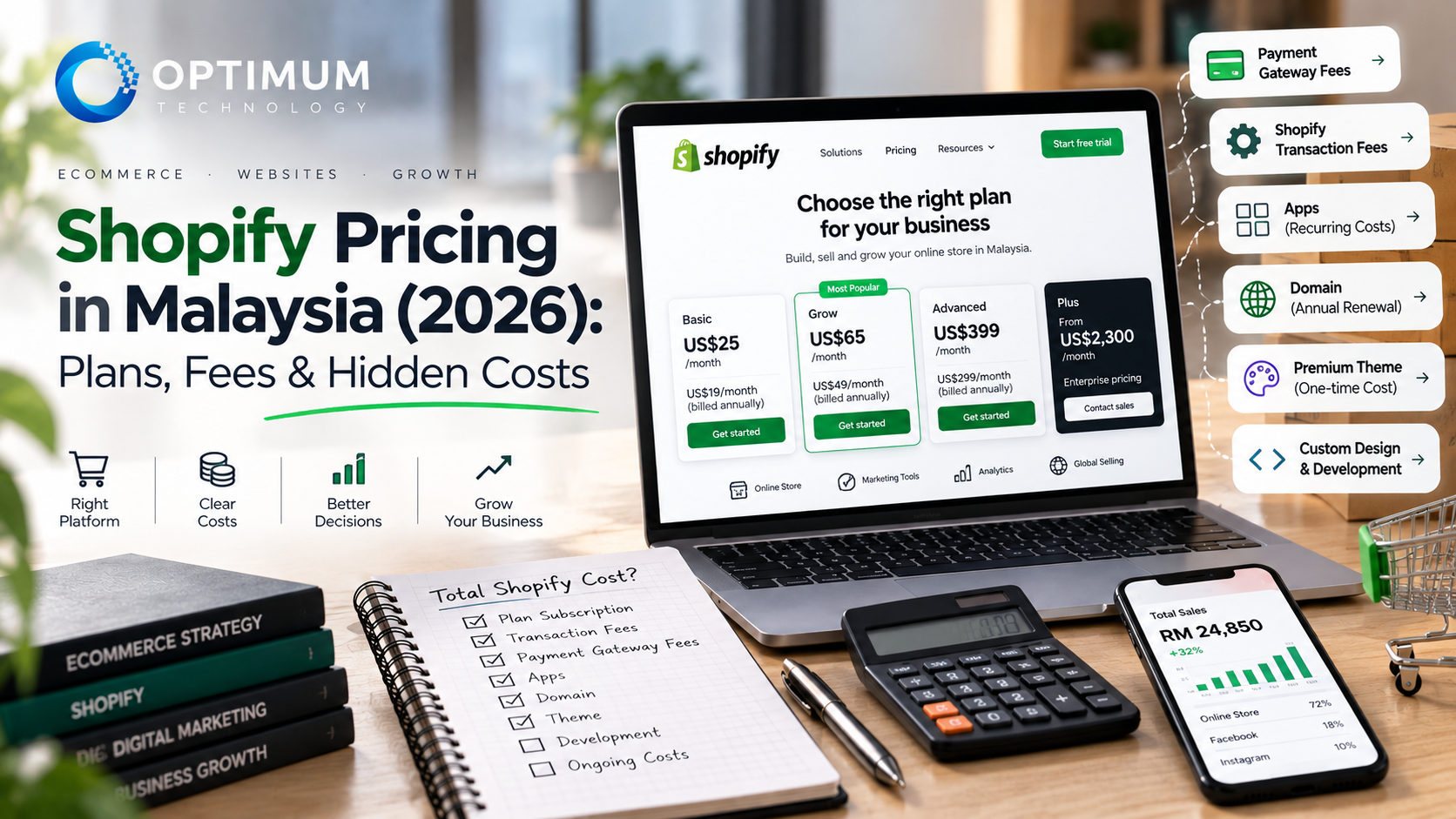
Shopify Malaysia Plans at a Glance
| Plan | Monthly Billing | Annual Billing |
|---|---|---|
| Basic | US$25/month | US$19/month equivalent |
| Grow | US$65/month | US$49/month equivalent |
| Advanced | US$399/month | US$299/month equivalent |
| Plus | From US$2,300/month on a 3-year term | Enterprise pricing depends on contract |
Pricing above is based on Shopify's Malaysia pricing page reviewed in October 2026. Shopify pricing, promotions and plan features can change, so confirm the current Malaysia pricing page before purchasing.
1. What Do the Shopify Plans Actually Change?
All three main Shopify plans can run a full online store.
The difference is not that Basic is a “demo” while Advanced is a “real store”.
Even Basic currently includes features such as:
- an online store,
- unlimited products,
- inventory management,
- hosting,
- SSL,
- marketing features,
- analytics and reporting,
- AI website tools,
- and access to Shopify apps.
The plan decision becomes more important when the business needs more staff access, more advanced operations or lower payment-related fees.
Basic is usually the most logical starting point for a new or small store where one main owner or team handles the operation.
Grow adds support for up to five additional staff accounts and is positioned for businesses with a small team and more consistent sales.
Advanced supports up to 15 staff accounts and adds features such as live third-party shipping rates and more capability for businesses selling across regions.
Shopify Plus is a different category. It is designed for more complex businesses and includes areas such as advanced checkout customisation, larger B2B requirements and higher-scale operations.
Most Malaysian SMEs do not need to begin with Plus.
2. The Biggest Malaysia-specific Cost: Payments
This is where Shopify pricing becomes more complicated for a Malaysian merchant.
As of October 2026, Malaysia is not listed among the countries currently supported by Shopify Payments.
That means a Malaysia-based business generally needs to connect a third-party payment provider to accept online payments.
That creates two possible layers of cost:
Shopify Transaction Fee + Payment Gateway Processing Fee
The payment gateway charges its own fee for processing the customer payment.
Shopify can separately charge a third-party transaction fee when an order is processed through an external payment provider.
The exact Shopify transaction rate depends on the plan and location, so it should be checked against the current Shopify pricing or store billing information before choosing a plan.
This matters because a business comparing payment gateways cannot look only at:
“Gateway A charges 1.5%, Gateway B charges 2%.”
You also need to understand what Shopify itself charges on top of the gateway.
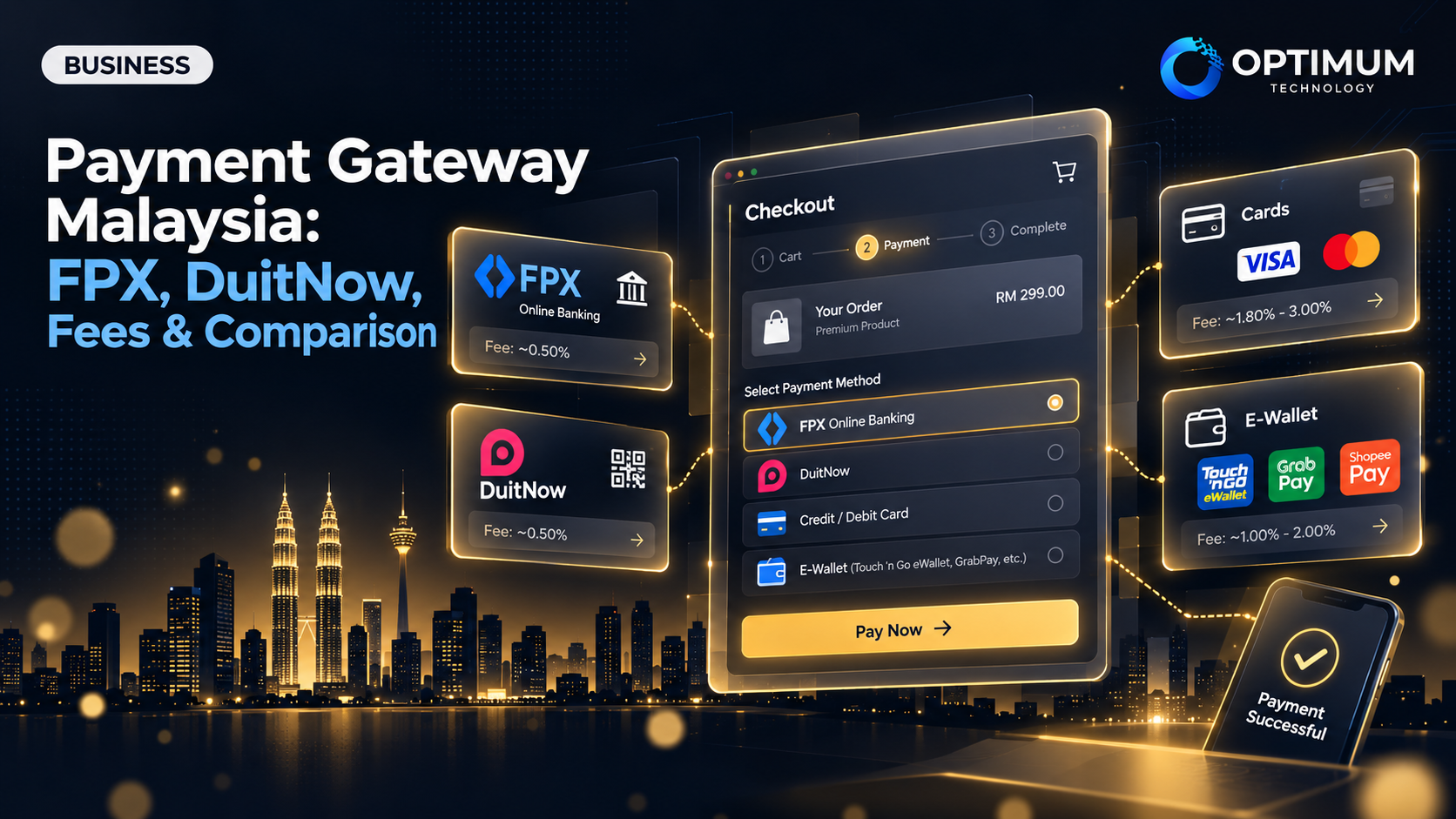
We explain Malaysia payment providers, FPX, DuitNow and gateway fee structures in our Payment Gateway Malaysia comparison.
3. What Is the Real Cost of Shopify in Malaysia?
A better way to budget Shopify is:
Shopify Plan + Shopify Transaction Fees + Gateway Fees + Apps + Domain + Theme / Design + Development = Real Cost
Each part behaves differently.
Shopify subscription
This is the predictable part.
The business chooses Basic, Grow, Advanced or Plus and pays according to the selected billing cycle.
Annual billing gives a lower effective monthly cost, but it also means committing more money upfront.
Payment gateway fees
Your payment provider charges for processing customer transactions.
The actual rate depends on the provider and payment method.
Cards, online banking, DuitNow or e-wallet methods may not all use the same fee structure.
Shopify third-party transaction fees
When a merchant uses a third-party payment provider, Shopify may charge a separate transaction fee according to the plan.
Shopify also states that these transaction fees are separate from the processing fee charged by the payment provider.
This is one of the most important costs for a Malaysian merchant to understand before selecting a plan.
Apps
Shopify's App Store is one of its biggest advantages.
It is also one of the easiest ways for a store's monthly cost to grow.
A business may add apps for:
- product reviews,
- subscriptions,
- loyalty programmes,
- advanced search and filtering,
- email or WhatsApp marketing,
- upsells,
- shipping,
- invoicing,
- marketplace synchronisation,
- or reporting.
Some apps are free.
Others use recurring subscription charges, usage-based fees or one-time charges.
App billing cycles can also be different from the main Shopify subscription cycle, so the final monthly bill may not always look as simple as one plan fee.
Domain
Hosting and SSL are included with Shopify, so a separate hosting plan is normally unnecessary.
A custom domain is different.
You can connect a domain you already own or purchase one through Shopify.
Domains purchased through Shopify are registered for one year and need to be renewed separately from the Shopify plan.
Theme
Shopify offers free themes, so a business does not need to buy a premium theme to launch.
But businesses that want a particular layout or more built-in design features may purchase a paid theme.
Theme purchases are generally a separate one-time cost rather than part of the Shopify subscription.
Design and development
Shopify can be launched without a developer.
That does not mean every Shopify store should be built without one.
A business may still pay for professional work such as:
- store structure and UX,
- custom theme design,
- product-page layouts,
- SEO architecture,
- payment setup,
- migration from another platform,
- custom apps,
- API integrations,
- tracking,
- or conversion optimisation.
That is project cost, not Shopify subscription cost.
4. 7 Shopify Costs Malaysian Businesses Often Miss
| Cost | Why It Gets Missed | What to Check |
|---|---|---|
| Third-party transaction fees | Businesses focus only on gateway rates | Check Shopify's fee for your plan and location |
| Gateway processing | Separate from Shopify subscription | Compare cards, FPX / online banking, DuitNow and wallets |
| Apps | Each app looks inexpensive individually | Add all recurring and usage-based fees together |
| Domain renewal | Hosting is included, so domain is sometimes forgotten | Check annual renewal separately |
| Premium theme | Not required, but often added during design | Decide whether a free theme already solves the requirement |
| Foreign-currency billing | Shopify Malaysia pricing is displayed in USD | Your RM cost can move with exchange rates and card FX charges |
| Development / migration | Subscription does not build the store for you | Budget separately for design, data migration and integrations |
There is also one billing detail worth remembering: recurring apps can follow their own billing cycles.
Uninstalling an app stops future billing through Shopify, but an already-generated pending charge may still appear on the next invoice. Apps billed externally may require a separate subscription cancellation with the app provider.
So if a Shopify store has accumulated many apps over time, it is worth reviewing them periodically instead of assuming every subscription is still necessary.
5. Should a Malaysian Business Start With Basic or Grow?
For many smaller businesses, the sensible answer is:
Start with Basic unless there is a specific reason not to.
The website itself is already fully capable of selling products.
Paying for Grow only makes sense if the additional staff access, operational features or payment-fee difference produces enough value to justify the higher subscription.
Advanced becomes more relevant when sales volume is much higher, the business needs more staff access, or the additional international and shipping capability matters operationally.
The mistake is choosing a higher plan because it sounds more professional.
Plan selection should follow:
Sales Volume → Team → Payment Fees → Required Features → Plan
not:
More Expensive = Better Store
6. When Does Shopify Stop Being the Cheapest Option?
Shopify is often economical because so much infrastructure is already included.
You do not need to build checkout, product management, hosting, SSL, order management and a basic commerce backend from zero.
But the cost equation starts changing when the business needs many paid apps and custom work to force Shopify into a workflow it was not designed for.
For example:
- complex B2B pricing rules,
- unusual quotation workflows,
- deep ERP integration,
- custom fulfilment logic,
- customer portals,
- special approval processes,
- or very specific checkout behaviour.
If the store requires ten separate apps plus ongoing developer work simply to reproduce the business process, it becomes worth asking whether the platform is still simplifying the operation.
That does not automatically mean a custom eCommerce website is cheaper.
Custom development creates its own build, hosting and maintenance responsibility.
The correct comparison is total cost and operational fit over several years.
Our eCommerce Website Development in Malaysia guide looks at the wider checkout and payment side of that decision.
Planning a Shopify or eCommerce website?
Do not choose the platform only from the advertised monthly price. Map the products, payments, integrations, SEO and customer journey first, then decide whether Shopify or another approach fits the business.
Explore Website Design → eCommerce · Shopify · Payment Integration · SEO · MalaysiaThe Bottom Line
Shopify itself is not necessarily expensive.
The mistake is assuming that the subscription is the entire operating cost.
For a Malaysian store, budget around this structure:
Plan → Payment Gateway → Shopify Transaction Fees → Apps → Domain → Design / Development → Ongoing Operation
Basic may be enough for a surprising number of businesses.
Grow and Advanced become more useful when team size, sales volume and operational requirements justify them.
Most importantly, Malaysia-based merchants should understand the payment setup before choosing a plan because Shopify Payments is not currently listed as available in Malaysia.
That makes third-party payment-provider costs especially important in the real Shopify budget.
Shopify plans, promotions, supported payment countries and fees can change. Pricing and feature information in this article was reviewed against Shopify's Malaysia pricing and Help Center pages in October 2026. Payment-provider fees vary by provider and payment method, so confirm current rates before making a platform decision.