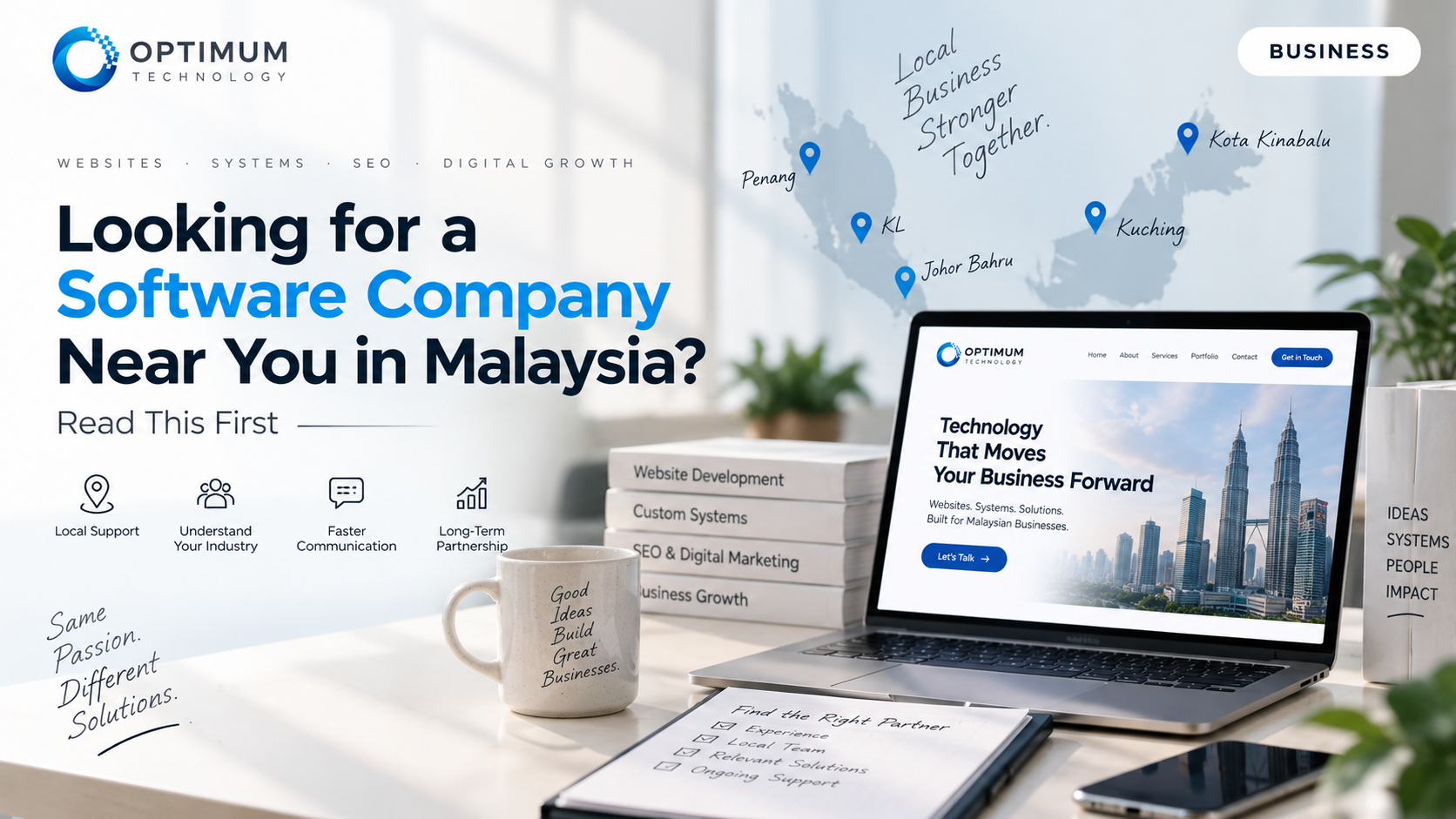
If you searched “software company near me”, there is a good chance you are not actually looking for the company with the shortest driving distance.
You are trying to find someone who can solve a technology problem without turning it into another problem.
Maybe your team is still managing operations in Excel. Maybe you need a customer portal. Maybe the current system no longer fits the business. Or maybe what you actually need is only a professional website.
Those are very different projects.
So before opening five tabs and asking every software company in Malaysia for a quotation, answer one question first:
“What are we actually trying to build or fix?”
What Type of Software Company Do You Actually Need?
| Your Problem | What You Probably Need | What to Look For |
|---|---|---|
| Need a professional online presence | Website Design / Web Development | UI/UX, CMS, SEO, mobile performance |
| Standard business process already has a solution | SaaS or Ready-made Product | Fast setup, predictable pricing, support |
| Excel and manual work no longer scale | Custom Web System | Workflow analysis, database, automation, integrations |
| Customers need to use the product on mobile | Mobile App or Responsive Web App | User experience, notifications, device features |
| Computers, servers or office infrastructure need support | IT Support / Managed Services | Infrastructure and support capability |
1. A Website and a Business System Are Not the Same Project
This sounds obvious, but businesses often send the same brief to completely different types of vendors.
If your requirement is:
Company profile, services, portfolio, contact form and Google visibility
you probably need a website team.
If the requirement is:
Staff login, approval workflow, customer records, reports, inventory, payments and automated processes
you are moving into software development.
A good website company is not automatically a good custom software company, and a highly technical development team is not automatically the best choice for a small corporate website.
If your project is mainly customer-facing marketing, our Website Design in Malaysia pricing guide explains what usually changes between RM3,000, RM10,000 and RM30,000 website budgets.
2. Check Whether You Need Custom Software at All
Custom software sounds attractive because everything can be built around your business.
But custom is not automatically the smartest option.
If the problem is already well solved by existing software — accounting, email, basic CRM, project management or another standard workflow — buying a mature SaaS product may be faster and cheaper.
You get something that already exists, has already been tested and can often be running within days.
The custom route becomes more interesting when the business keeps saying things like:
- “Our process does not fit the software.”
- “We enter the same information into three systems.”
- “Staff are exporting everything back into Excel.”
- “This approval process is unique to our company.”
- “We need the system to connect with another internal platform.”
We have explored that trade-off in more detail in Why Malaysian Enterprises Choose Custom Software Over SaaS.
3. There Is Also a Middle Ground: Ready-made Software
The decision is not always:
SaaS from a global company vs build everything from zero.
There is a middle category: a ready-made product designed for a specific business workflow.
For example, a class-based studio may not need a completely custom booking platform. A product that already handles classes, packages, credits, payments and renewals could solve the problem much faster.
This model usually gives up some customisation in exchange for lower upfront cost and faster implementation.
Before paying for custom development, ask:
“Does something already exist that solves 80–90% of this properly?”
If the answer is yes, buying the existing product may be the more sensible business decision.
4. Does the Software Company Really Need to Be Near You?
Sometimes yes.
Sometimes no.
If you only need a straightforward website, a capable team in another Malaysian state can usually work remotely without much difficulty.
But location starts to matter more when the software touches daily operations.
Imagine replacing a workflow used by Sales, Finance, Operations and Management every day.
The development team may need to understand:
- who currently performs each step,
- which exceptions happen in real life,
- which approvals matter,
- which existing systems must connect,
- and what staff actually do when the official process breaks.
For those projects, being able to meet the team, run workshops and stay in the same business hours can make communication easier.
But proximity should still be a secondary filter.
A weak company five minutes away is not a better choice than a strong company two hours away.
Do you need software — or just a better process?
Start with the workflow before deciding the technology. A good software discussion should clarify the problem first, not immediately sell the largest build.
Explore Custom System Development → Workflow · Automation · Web Apps · Integrations5. Look at Relevant Projects, Not Just Pretty Screens
A software portfolio should tell you more than whether the company can design a nice dashboard.
Look for projects that show similar complexity.
If you need a property-management platform, ask whether the team has built systems with payments, residents, access control or multi-property management.
If you need financial software, ask about permissions, audit trails, reporting and regulatory requirements.
If you need an internal operations system, look for evidence of workflow automation rather than only public websites.
The industry does not have to match perfectly.
The important question is whether the team has solved technical and operational problems at a similar level.
6. Ask Who Will Actually Build the Software
The people in the sales meeting are not always the people writing the code.
That is not automatically a problem. Many software companies use external specialists successfully.
But you should know the delivery model before signing.
Ask:
- Is development done in-house or outsourced?
- Who is responsible for architecture?
- Who will manage the project?
- Can we speak directly with the technical team when necessary?
- Who handles the system after launch?
The important thing is accountability.
If a production problem appears six months later, you should know which company and team are responsible for solving it.
7. Who Owns the Source Code?
This question should be answered before development starts.
Custom software can involve several different ownership models.
The business may own the completed source code. The developer may retain ownership and license the system to the client. Some reusable libraries may also remain the property of the developer.
None of those structures is automatically wrong.
The problem is discovering the arrangement only when you want another developer to maintain the system.
Ask the quotation or agreement to explain:
- who owns the custom source code,
- where the repository is stored,
- whether the business receives access,
- what third-party components are used,
- and what happens if the development relationship ends.
If ownership matters to your business, put it in writing.
8. Ask Where Your Data Goes
This matters even more when the system stores customer, employee, financial or other personal information.
Do not stop at:
“The system is secure.”
Ask practical questions:
- Where will the system be hosted?
- Who can access production data?
- How are passwords and permissions handled?
- How often are backups created?
- What happens after a security incident?
- Are third-party services processing personal data?
- Can access be removed when staff leave?
For Malaysian businesses processing personal data, this is also part of a wider compliance responsibility rather than only a technical feature.
Your software vendor does not replace your legal or compliance obligations, but it should be able to explain how the system supports sensible data protection and security practices.
9. Compare Quotations by Scope, Not Only Total Price
One software company quotes RM30,000.
Another quotes RM80,000.
That does not automatically mean the second company is expensive.
They may not be quoting the same project.
Check whether each quotation includes:
- Discovery and requirement analysis
- UI/UX design
- Frontend development
- Backend development
- Database design
- Third-party integrations
- Testing and UAT
- Data migration
- Deployment
- Training
- Hosting
- Post-launch support
A quotation that excludes migration, testing and support can look cheaper until those items become necessary later.
Ask for enough detail that you can compare the same scope.
10. Be Careful With Both Extremely Fast and Extremely Long Timelines
Software timelines depend heavily on scope.
A simple internal dashboard and a multi-role enterprise platform should not have the same delivery schedule.
If a company promises a complex custom platform in two weeks without understanding the requirement, ask what exactly will be delivered.
But a project should not disappear into development for six months without anything visible either.
A healthier process usually gives the client opportunities to review progress through prototypes, milestones, staging environments or regular demos.
You should be able to see whether the project is moving in the right direction before the final delivery date.
11. Ask What Happens After Launch
Launch is not the end of a business system.
Real users will find edge cases that nobody discovered during planning.
The business may add staff, change a process, open another branch or need a new integration.
Before signing, understand:
- how the warranty period works,
- what counts as a bug,
- what counts as a new feature,
- how support is charged,
- how urgent issues are handled,
- and whether the same company can continue maintaining the system.
The cheapest build can become expensive if every small change requires finding a new developer who first has to understand someone else's code.
Warning Signs Before You Sign
Software Company Red Flags
| Red Flag | Why It Matters | What to Ask |
|---|---|---|
| Quote before understanding workflow | Scope may be guessed | What assumptions is this price based on? |
| No clear code ownership | Future maintenance may become difficult | Who owns and receives the repository? |
| No staging or review process | You may only see problems at the end | When can we review working versions? |
| Everything is “included” | Scope boundaries are unclear | What specifically is not included? |
| No post-launch plan | Business systems need ongoing support | Who supports the system after go-live? |
Where Optimum Technology Fits
Optimum Technology is a software development company with teams in Johor Bahru and Kuala Lumpur.
Our work covers websites, web applications, mobile apps and custom business systems, with projects across areas such as property, fintech, manufacturing and internal operations.
For custom development, our approach is to understand the workflow first, plan the UI and architecture, build through staged development and continue supporting the system after launch.
Our development is handled by our in-house Malaysian team, and clients own the custom source code we deliver.
That model makes the most sense when the software matters to the business over time — not when you simply need a generic tool that an existing SaaS product already solves well.
If an existing product is the better answer, we would rather identify that before turning a simple problem into a custom development project.
Have a software problem but not sure what you need?
Start with the workflow. Tell us what your team is doing manually, what is slowing the business down and what the current tools cannot handle.
Explore Customize System → JB & KL Team · In-house Development · Source Code Ownership · Ongoing SupportThe Bottom Line
Searching for a software company near you in Malaysia is a reasonable place to start.
But distance should not be the first thing that decides the project.
First decide whether you actually need:
Website → Ready-made Product → SaaS → Custom System → Mobile App → IT Support
Then compare companies that are genuinely good at that type of work.
For custom development, pay particular attention to:
Relevant Experience → Workflow Understanding → Technical Team → Code Ownership → Data Handling → Delivery Process → Support
A nearby team can be valuable when the project needs close collaboration.
But the best software company is not simply the closest one.
It is the team that understands the problem, builds the right level of solution and is still accountable after the software goes live.
Looking for a software team in Malaysia?
Optimum Technology builds websites, web apps, mobile apps and custom systems from Johor Bahru and Kuala Lumpur, with the development and support handled by our own local team.
Discuss Your Project → 100+ Projects · Malaysia Team · You Own the Code · Ongoing SupportNot every business needs custom software. If an existing product solves the problem properly, it may be faster and more economical than building from scratch. Custom development makes the most sense when the workflow, integrations or business rules genuinely require it.